Planning a weekend itinerary in Rome filled with traditional Italian food, free walking tours, and hidden local restaurants? This travel guide is for you. On the first day of our Rome getaway, we explored ancient ruins, discovered legendary fountains, took part in a free walking tour (yes, those really exist!), and finished the day with a dream dinner at one of the best Roman trattorias. Whether you’re building your Rome weekend itinerary or just looking for a relaxed escape packed with history and flavor, the Eternal City is always a great choice.
There’s something magical about waking up early and hitting the streets of Rome on foot, with the sun slowly warming the ancient cobblestones. The sound of fountains, the aroma of coffee and fresh cornetti drifting from cafés, and the promise of a day filled with discoveries make this city truly unforgettable. Whether you’re passionate about history, architecture, food, or just love relaxed strolls through beautiful streets, Rome will steal your heart.
👉 Planning more city breaks? Check out:
– A Perfect Day in Lisbon – Culture, Food, and Scenic Views
– What to See in Oslo in 24 Hours – Islands, Museums, and Local Food
– One Day in Munich – History, Beer, and Beautiful Gardens
Late Arrival, But the Perfect Location
We arrived in Rome on a Friday night, quite late. The airport was calm, and within minutes we were in an Uber heading to our Airbnb. (P.S.: If you want a discount on your first Uber ride, click here!) We usually book accommodations through Booking.com or Airbnb — both are super convenient, easy to manage or cancel, and full of real reviews and ratings from other travelers. Planning a trip soon? Click this link to get a discount on your first Airbnb booking.
Our apartment was in a perfect central location, right in the heart of the city — which made all the difference the next day when we explored everything on foot. In Rome, where every corner tells a story and every street feels like a step back in time, staying central isn’t just convenient — it’s essential.

Early morning light over Monti, one of Rome’s most charming and central neighborhoods. Just a short walk from our Airbnb, this quiet street led us straight into the heart of the city’s ancient wonders. From here, the Colosseum and Roman Forum were only minutes away — the perfect base for exploring Rome on foot.
The Roman Forum: Heart of Ancient Rome
Our first major stop of the day was the Roman Forum (Forum Romanum) — one of the most iconic historic sites in the city. This open-air space, surrounded by hills, was once the political, religious, and commercial heart of Ancient Rome. Imagine it as the city’s central square, where everything from public speeches to markets and celebrations took place.

Early morning at the Roman Forum, one of the most iconic archaeological sites in Rome. The golden sunlight highlights the ancient columns and ruins, creating a magical contrast with the clear blue sky.
Here you’ll find the remains of some of the most important structures of the Roman Empire: temples dedicated to gods like Saturn and Vesta, the Curia where the Senate met, the Basilica of Maxentius, and triumphal arches like those of Titus and Septimius Severus. Walking through these ruins truly feels like stepping back in time — over two thousand years.
It’s a place that breathes history. The stones beneath your feet once echoed with imperial speeches, victorious processions, legal trials, and daily Roman life. Today, even though only columns, arches, and broken walls remain, the scale and importance of this space are still overwhelming. The view toward the Colosseum in the distance, combined with the sound of swallows circling overhead, makes this one of the most atmospheric and unforgettable places to visit in Rome.
Vittoriano: Monument to Italian Unity
Right next to the Roman Forum, in Piazza Venezia, rises the imposing Monument to Victor Emmanuel II, also known as the Vittoriano or Altar of the Fatherland (Altare della Patria). This massive white marble structure was built at the end of the 19th century to honor Victor Emmanuel II, the first king of a unified Italy.
The monument is somewhat controversial among Romans — some see it as too grand or over-the-top, while others admire its scale and symbolic power. Either way, it’s impossible to miss. With its massive Corinthian columns, sweeping staircases, statues, and the eternal flame, the Vittoriano represents the birth of modern Italy, after centuries of fragmentation between kingdoms and independent states.

The Vittoriano in Rome, also known as the Altar of the Fatherland, stands proudly in Piazza Venezia — a grand tribute to Italy’s first king and national unity.
At the top, you’ll see two bronze quadrigas (chariots pulled by horses) and a panoramic view over central Rome. You can also visit the Museum of Italian Unification inside the monument and see the Tomb of the Unknown Soldier, guarded by soldiers and marked with an eternal flame — a solemn tribute to those who died in the wars of unification. For anyone interested in modern Italian history or national landmarks, this is a must-see stop on any Rome walking itinerary.
Largo di Torre Argentina: Ancient Temples, Cats… and Julius Caesar?
One of the most unexpected highlights of our Rome walking tour was Largo di Torre Argentina — a seemingly modest square tucked between busy streets, yet full of historical significance. At first glance, it might look like just another set of Roman ruins. But this site hides two fascinating secrets: it’s home to a cat sanctuary, and it’s believed to be the place where Julius Caesar was assassinated.

A morning view of the archaeological site at Largo di Torre Argentina in Rome, where ancient Roman temples meet modern city life. This is also where Julius Caesar was famously assassinated.
The square contains the remains of four Roman temples, built between the 4th and 2nd centuries BC, along with the ruins of the Curia of Pompey, where many historians believe Caesar was stabbed by senators in 44 BC. While the exact location of Caesar’s assassination is still debated, most agree it happened right here — giving the site a dramatic and almost cinematic aura.
Today, the ruins are fenced off and preserved, but can be easily admired from all sides of the square. And the most charming twist? Since the 1990s, the site has been home to a protected colony of stray cats, cared for by local volunteers. The cats live among the ruins, nap on ancient columns, and are fed and looked after by a small organization based at the site. It’s a striking contrast between ancient Roman grandeur and soft, everyday tenderness.
Visiting the Largo di Torre Argentina is no longer free — there’s now an entrance fee, with different prices depending on whether you’re a local resident or a visitor. To check the current ticket prices, click here.
For history buffs, animal lovers, or anyone who enjoys unexpected corners of Rome, this place is a gem. A true hidden treasure that rewards those who let themselves wander.
Italian Breakfast at Gran Caffè Rione VIII
After a busy morning of walking, we stopped for a much-needed break at Gran Caffè Rione VIII, a cozy café with glass counters full of tempting Italian pastries. We picked two traditional sweets that looked impossible to resist: one filled with pistachio cream, the other with lemon custard. Both were made with light, flaky pastry, generously dusted with powdered sugar. Paired with a well-made espresso, it was the perfect combo to recharge and enjoy a quiet moment in the city.

A delicious Italian breakfast featuring flaky pastries filled with pistachio and lemon cream, perfect for a sweet start to the day in Rome.
The food itself was genuinely good — authentic flavors and fresh ingredients. However, the service was far from ideal: it was disorganized, slow, and not very attentive. The staff seemed overwhelmed, rushing back and forth without much coordination. Still, it was worth the stop for the pastries alone, and we appreciated the chance to sit down, sip our coffee, and soak up the Roman morning atmosphere.
Free Walking Tour with GuruWalk: A Smart Way to Explore Rome
One of the smartest decisions we made that day was joining a free walking tour in Rome through the GuruWalk platform. We’ve done these in other cities before and loved them, and once again, it didn’t disappoint. This time, we spent about two hours walking through Rome, guided by a passionate local who showed us lesser-known spots and shared fascinating stories and historical context about the Eternal City.
This wasn’t our first time with GuruWalk — we’ve also joined their tours in Finland (click here to read about that trip), in Cusco, Peru, during our culinary journey through the Andes, and in Lyon, France, and Copenhagen, Denmark. Each experience has been consistently positive.
Aside from being budget-friendly (you tip the guide what you feel the tour was worth), it’s also a genuine way to connect with the city through the eyes of a local. You get to ask questions, discover places you’d likely miss on your own, and walk away with a much deeper understanding of the place — its culture, daily life, and even food traditions. We highly recommend it to any curious traveler looking for an authentic experience.
The Pantheon: A Marvel of Roman Engineering
One of the most breathtaking stops on our walk through Rome was the Pantheon — not only one of the best-preserved buildings from Ancient Rome, but also one of the most impressive. It’s impossible not to be amazed the moment you step inside: a massive dome with no visible supports, topped by a central oculus that lets in natural light, creating a quiet, almost mystical atmosphere.
The current structure was built in the 2nd century AD, during the reign of Emperor Hadrian, on the site of an earlier temple commissioned by Marcus Agrippa. The original inscription on the front — M·AGRIPPA·L·F·COS·TERTIVM·FECIT — still stands, honoring Agrippa as the original builder. The name Pantheon means “temple of all gods,” as it was originally dedicated to the entire Roman pantheon.

The majestic Pantheon stands tall in Piazza della Rotonda, drawing visitors from around the world to admire its ancient Roman architecture and timeless beauty.
The building’s architectural harmony is astonishing — the diameter of the dome is exactly equal to the building’s height (about 43 meters), creating a perfect sphere inside a cylinder. The central oculus not only lights the space beautifully, but also lets in rain, which drains through small holes in the floor — another brilliant design detail from Roman engineers.
Today, the Pantheon is a consecrated church and the burial place of notable figures, including the artist Raphael and the kings Victor Emmanuel II and Umberto I.
As of recently, there’s a small entrance fee: €5 for adults, €2 for EU citizens between 18 and 25, and free admission for those under 18.
We recommend booking your tickets online in advance, especially during peak travel season, as time slots can sell out quickly and the line gets long.
It’s one of those places where time feels suspended — where architecture, history, and spirituality come together in a way that only Rome can offer. We stayed there for quite a while, just looking up in awe, trying to grasp how something so perfect could have been built nearly two thousand years ago.
The Column of Marcus Aurelius: History Carved in Stone
As we continued exploring central Rome, we came across the striking Column of Marcus Aurelius in Piazza Colonna. It may not be as well-known as the Colosseum or the Roman Forum, but it’s one of those monuments that quietly impresses you with its fine detail and exceptional state of preservation.
The column was built in the late 2nd century AD to commemorate the emperor’s military campaigns against Germanic and Sarmatian tribes. Much like Trajan’s Column, it features a spiral relief that wraps around the shaft, depicting battle scenes in intricate detail. If you look closely, you’ll see soldiers, fortresses, bridges, weapons, and even symbolic moments like the “miracle rain” that, according to legend, saved the Roman army during a drought.

A striking view of the Column of Marcus Aurelius in Piazza Colonna, a masterpiece of Roman sculpture celebrating the emperor’s military victories.
It’s a true visual narrative carved in stone, with more than 2,000 figures spread over its 30-meter height. Today, a statue of Saint Paul sits atop the column (added in the 16th century), but it originally held a statue of Marcus Aurelius himself. Interestingly, the column is hollow inside, with a spiral staircase — though it’s not open to the public.
If you’re nearby, it’s well worth pausing for a moment to admire this surviving piece of imperial Rome, standing tall in the midst of modern city life — a quiet yet powerful reminder of the empire’s grandeur.
Trevi Fountain: Beauty, Legends… and a Line
No trip to Rome is complete without a stop at the Trevi Fountain. Even if you’ve seen it in movies, postcards, or countless Instagram photos, nothing compares to seeing it in person. The fountain reveals itself almost theatrically, tucked at the end of a narrow street — and you hear the sound of the water before you even see it.
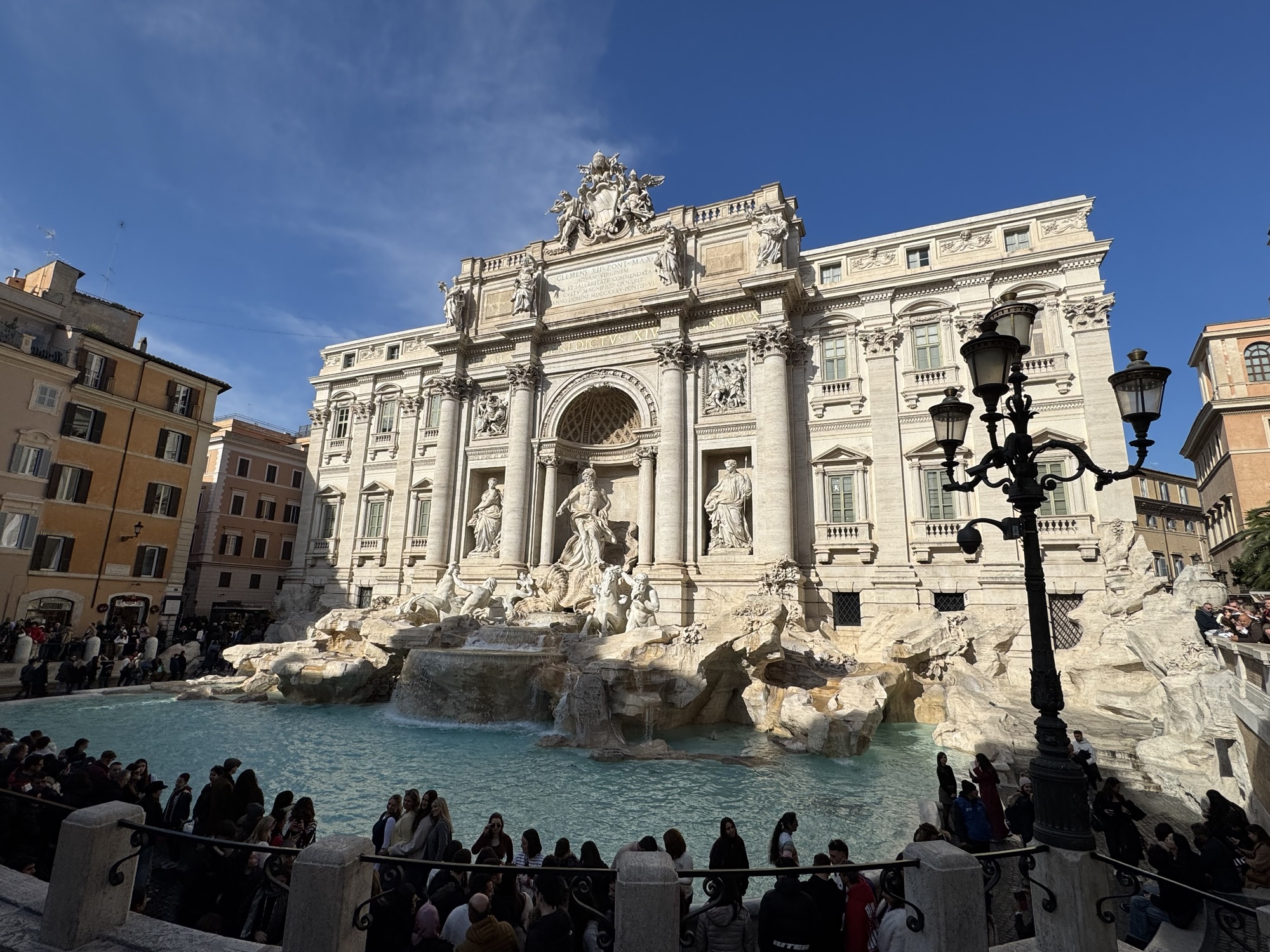
Designed in the 18th century by Nicola Salvi and completed by Giuseppe Pannini, the Trevi Fountain is a perfect example of Roman Baroque architecture: dramatic sculptures, movement, theatricality, and flowing water everywhere. At its center is Neptune riding a shell-shaped chariot drawn by sea horses, surrounded by tritons and Corinthian columns. The theme celebrates the power of water and its importance to the Roman Empire and its aqueducts.

The iconic Trevi Fountain in Rome, a baroque masterpiece where visitors toss coins to ensure their return to the Eternal City.
Of course, we did the classic ritual: tossing a coin over our right shoulder with our left hand, facing away from the fountain. According to the legend, this guarantees a return to Rome.
But there’s a big update: to take photos right next to the water, you now need to enter a controlled access area, limited to about 400 people at a time. The entry is via the central staircase, and the exit is on Via dei Crociferi. This system was recently introduced to improve visitor flow and safety. The visiting hours are daily from 9:00 AM to 9:00 PM (last entry at 8:30 PM).
On Mondays and Fridays from 12:00 PM, the coins thrown into the fountain are collected. On two Mondays each month, between 2:00 PM and 9:00 PM, the basin is emptied and cleaned. After 9:00 PM, access becomes free again — a great tip for those who want to enjoy the fountain at night, with fewer crowds and magical lighting.
Hidden Lunch Spot: Pizza and Bruschetta in a Quiet Side Street
After walking around all morning, lunch felt like paradise. We stumbled upon Dar Poeta, a charming little pizzeria tucked away in a narrow alley in Trastevere — far from the tourist chaos but still easy to reach on foot. The indoor space is small but cozy, with stone walls, simple décor, and that irresistible smell of a wood-fired oven. But the real charm was outside: a shaded terrace with several tables, perfect for hot summer days. It was warm, but sitting there in the shade, it felt like the best kind of break.
We started with a classic bruschetta — crusty rustic bread, ripe tomatoes, and fresh basil — simple and full of flavor.

A classic bruschetta from Trastevere in Rome — toasted bread topped with juicy tomatoes, olive oil, and a hint of garlic. Simple, fresh, and full of flavor.
Then came the pizza: thin crust, slightly crisp edges, and ultra-fresh ingredients. It was just the right size: satisfying without being too heavy. The combination of the homemade tomato sauce and melted cheese was spot on — balanced and comforting without overdoing it.

A classic Roman pizza from Trastevere with a thin, crispy crust, topped with fresh tomato sauce, mozzarella, and mushrooms — simple and authentic.
The service was relaxed and friendly, with no rush and no fuss. It was one of those moments where everything just felt right: excellent food, a chilled atmosphere, and the joy of discovering a place you’d want to keep secret. If you’re visiting Trastevere, definitely stop by — just don’t tell too many people, so we can still get a table next time.
A Stroll Through Trastevere: Cobblestones, Colors, and Local Charm
After our satisfying lunch at Dar Poeta, we took some time to wander through the charming streets of Trastevere — one of Rome’s most atmospheric neighborhoods. It’s a place full of life and contrast: narrow cobblestone alleys, laundry hanging from balconies, faded terracotta walls covered in ivy, and the occasional scooter zipping by. It’s exactly what you imagine when you think of authentic, local Rome.
Without any particular destination, we let ourselves get lost for a while — peeking into hidden courtyards, admiring old doorways, and stopping at the occasional boutique or artisan shop. The neighborhood has a relaxed, bohemian vibe, and the early afternoon light made everything look even more beautiful.

A charming street in Trastevere, filled with locals and tourists enjoying the cafés and warm Roman atmosphere.
If you’re looking for a real Roman experience away from the crowds, walking through Trastevere after lunch is a perfect choice. It’s a moment to slow down, digest (literally and figuratively), and soak in the everyday beauty of the city.
Afternoon Break: Espresso, Italian Pastries, and a Well-Deserved Pause
In the late afternoon, we took a break at a charming outdoor café — the perfect spot to rest after hours of walking through Rome. The setting was simple but welcoming, with wooden tables and bamboo planters separating us from the street. Just enough to create a calm, shaded corner away from the noise.
We ordered two classic Italian coffees: a strong, full-bodied espresso, confidently served in a small cup, and a creamy cappuccino with velvety foam and a heart-shaped design on top. To go with it, we picked two Italian pastries made with flaky dough and filled with sweet cream — one had a golden custard filling, the other a smooth white filling with crushed pistachios on the edges.

A cozy afternoon snack in Trastevere: rich espresso, creamy cappuccino, and two freshly filled cannoli with pistachio and custard filling.
Both were absolutely delicious — light, crispy, fresh, and with just the right balance of sweetness and texture. It was a sweet pause, literally, and well deserved. One of those simple travel moments that remind you why it’s so good to slow down, sit back, and just enjoy.
Sunset Walk in the Giardino degli Aranci
After our snack, we headed to one of our favorite places in Rome to relax: the Giardino degli Aranci, or Orange Garden, perched on Aventine Hill. This small public park is a peaceful green escape with one of the best panoramic views of Rome. It’s one of those places where the beauty is not only in what you see — but also in what you feel.
As soon as you enter, the scent of orange trees fills the air, and the sound of the city fades away, as if you’ve stepped into a different world. The trees line gravel paths that offer cool shade — perfect on a hot summer day. There are stone benches, low walls to sit on, and locals walking quietly or admiring the view.

A peaceful sunset over the rooftops of Rome — the perfect way to end a day exploring the Eternal City.
At the far end of the garden, you reach the viewpoint overlooking the Tiber River, the rooftops of Trastevere, and the majestic dome of St. Peter’s Basilica glowing in the golden evening light. It’s a romantic and peaceful place — perfect for a quiet moment away from the crowds. We sat there for a while, taking it all in: the sunset, the silence, and the feeling of being completely present.
This garden is a hidden gem in Rome, and a must-visit if you want to rest your feet and feed your soul with a view you’ll never forget.
An Unforgettable Dinner at Flavio al Velavevodetto
To end the day on the highest note, we reserved a table at Flavio al Velavevodetto, a beloved traditional restaurant in the Testaccio neighborhood — known among locals as a true haven for authentic Roman food. Far from the tourist traps, this is the kind of place Romans recommend to each other, and for good reason.
The restaurant is built right into the side of Monte Testaccio, and the interior strikes a perfect balance between rustic charm and cozy elegance: exposed brick walls, warm lighting, white linen tablecloths, and the gentle hum of people who are there to enjoy a good meal. There’s also an outdoor terrace, ideal on warm evenings, with its own unique atmosphere.
We started with a few simple but well-seasoned appetizers, and from that point on, everything kept getting better. One of the standout dishes was the pasta with octopus — wide ribbons of pasta cooked al dente, served in a rich tomato sauce with generous chunks of tender, flavorful octopus. The sauce was deep and slightly spicy, infused with herbs that enhanced the fresh Mediterranean seafood flavor. A bold dish, yet perfectly balanced.

Dinner in Testaccio — handmade tagliatelle with a rich seafood and tomato sauce, full of flavor and perfectly cooked.
We also tried a fusilli pasta with pesto and ground meat, tossed in a creamy, vibrant green sauce, and topped with grated cheese. It was an unusual combination, but deeply comforting — the kind of home-style flavor that surprises with its honest simplicity.

Fusilli pasta tossed in a creamy green pesto-style sauce with ground meat, finished with a generous sprinkle of grated cheese.
Next came the breaded meatballs, crispy on the outside and soft on the inside, served with sautéed spinach in olive oil and garlic, and roasted potatoes, golden and well seasoned. It was the kind of meal that warms your heart as much as your stomach — satisfying and full of soul.

Crispy breaded meatballs served with golden roasted potatoes and garlicky sautéed greens — a hearty and comforting Roman dinner enjoyed in the Testaccio neighborhood.
And finally, my dish: braised rabbit. Slow-cooked in a rich tomato sauce with black olives and aromatic herbs, the meat was incredibly tender and fell apart with a touch of the fork. It was one of those dishes that makes you stop and say, “this is it.” Deep flavor, perfect texture, and that rustic, familiar touch you only find in places that cook with love.

A hearty plate of braised rabbit served in a flavorful tomato and olive sauce, garnished with herbs. This traditional Roman dish was the highlight of our dinner in Testaccio — rich, rustic, and full of depth, just like the local cuisine should be.
It was, without a doubt, the best meal of our trip. A true celebration of traditional Roman cuisine, made with care, honesty, and zero pretension. It’s the kind of restaurant you know you’ll return to — and one we’d wholeheartedly recommend to anyone who appreciates real, soulful food.
A Day in Rome We’ll Always Want to Repeat
And just like that, our first day in Rome came to a close — filled with ancient ruins, unforgettable food, and timeless moments. We walked through streets that have seen centuries of history, tasted dishes that made us close our eyes with joy, and felt that unique energy that only Rome can offer. It’s truly amazing how much this city gives you — even in just a single day.
And the best part? We were only just getting started.
On day two, we delved even deeper into Rome’s soul: we visited the iconic Colosseum, explored the majestic Basilica of Santa Maria Maggiore — where Pope Francis was laid to rest in April 2025, as he had requested — indulged in the best tiramisu of the trip, enjoyed creamy artisanal gelato, and discovered a lunch spot that we know we’ll never forget.
If you’ve enjoyed this perfect one-day Rome itinerary and want to keep following our journey, stay tuned for the next post — coming very soon.
And if you’re planning other city getaways, check out more of our travel stories:
• One Perfect Day in Oslo – Island Hopping and Local Food
• Two Days in Lisbon – Fado, Food, and Memories
• Flavors of Finland – An Unexpected Culinary Journey
Have you ever been to Rome or anywhere in Italy? We’d love to hear your favorite spots — share your tips and stories in the comments!
Leave a Reply to Best International Trips for 2025: 25 Cities and Islands You’ll Love – Flight PantryCancel reply